Changing Times, Transforming Neighbourhoods
Transforming Relationship with Homes
This section captures the transforming relationship of residents living in these three immediate vicinities with respect to their homes. Here, we have detailed the responses of people to the immediate impacts associated with their housing which was categorised into the following overarching themes. These key findings are from the sample of residents, who were chosen based on their immediate proximity to the metro site.
When the construction project was started, there were narratives around the possible acquisition of private property in the vicinity with residents of all three settlements sharing about the same which ultimately didn't take place.There were mainly two kinds of responses that emerged.

Fear of Losing the Home
Fear of losing the home emerged as a key issue, especially for the residents who were living in the first lane closest to the construction site. When the construction project was started, there were narratives around the possible acquisition of private property in the vicinity with residents of all three settlements sharing about the same, which ultimately didn't take place.

"Yahaan wo metro wale aye the door to door bolne ki agar jaroorat padi to jagah khali karni padegi, par unhone abhi tak aisa nahi kiya."
(Mohan, 47, Social Worker)
In residents from Gandhi Gramam, this fear over the possible loss of home was greater than the residents residing in Pottery Town and William’s Town since they did not have legal security of tenure, especially for the ones who had not renewed or registered their expired swadheena patras and hakku patras.
"Yahaan kuch logo ka registration nahi hai, kyunki uska fees jyaada hai (Rs. 50,000 - 2,00,000) to usi wajah se logome dar tha."
(Silvi, 60, Resident)

For these residents of Gandhi Gramam as well as some older residents of William’s Town, the possible prospect of the government acquiring their properties in return for a financial amount was not an attractive enough deal since it meant losing their individual homes. Their relationship to the home was based on both an emotional as well as a financial understanding of what that property meant to them
They believed that money can’t compensate for the value of their home even if the amount accounts to being 4 times larger than the actual price and those who move away can’t be in peace as this is where they grew up.
"Metro mein kuch galti nahi hai. Government wale market rate se 4 guna zyaada deta toh acha hi hai na... Even though it will be good, lekin ghar chola jayega. Paisa aagaya aur ghar chala gaya toh kya faayda?"
(Raju, 72, Resident)
Some of the residents also shared how they took actions to prevent and safeguard this threat of loss of home, by approaching metro officials and had a meeting with Srinivas, the then MLA of the ward, either individually or in a group.
The potter residents mostly responded positively to the metro and didn’t perceive it as a threat. However, their concerns stemmed towards the legal tenureship of their leased land which expired in 2008. They worried that the incoming of the metro will propel state action towards acquisition of this leased land and force them to move from their workplaces. For few potters who continued to reside in these workplaces, this threat was also linked to their homes.

Metro se kuch problem nahi hai, lekin ye jagah par politicians logon ka ankh hai. Metro ke vajah se land ka value badh raha hai, isliye humne Sadashiva Nagar mai aakar matka protest kiya tha."
(Chandrashekhar, 51, Potter)
Within the category of potter residents, the younger generation of people within these potter families were initially similarly worried about the threat of losing their familial workplaces. However, their response to this impending threat was to approach NGO’s, youtubers and the media to create awareness and get public traction about what is happening while leveraging the cultural identity of this neighbourhood as Pottery Town and their identity of being potters.
"I don't think metro is a problem for us, they are not asking us to migrate. They don't have a problem with our community. It is because of political things - like people don't feel like there should be a place like Pottery Town beside the metro, because they want a commercial place that pays them right. So we were having problems initially when the project started, and we were given a notice to migrate. These problems happened, and we sought help from NGOs, YouTubers, media, to send a warning to people that this is happening”
(Shahida, 24, Potter)
Selling of Properties
Those residents who were ready to sell off their properties responded this way for varying reasons. A few felt there was no point in going against the interest of the government officials and would have to give up their land anyway, while there were responses associated with not having good relations with the neighbours and selling the property off would be a good deal.
"I don't have any issues at all... and in case they want our land, we cannot go and stop them. We cannot go and say 'stop this'. When the project and everything is allocated, you cannot go and say 'no, I am not going to'. They are going to take it out"
(Saleem, 38, Resident)
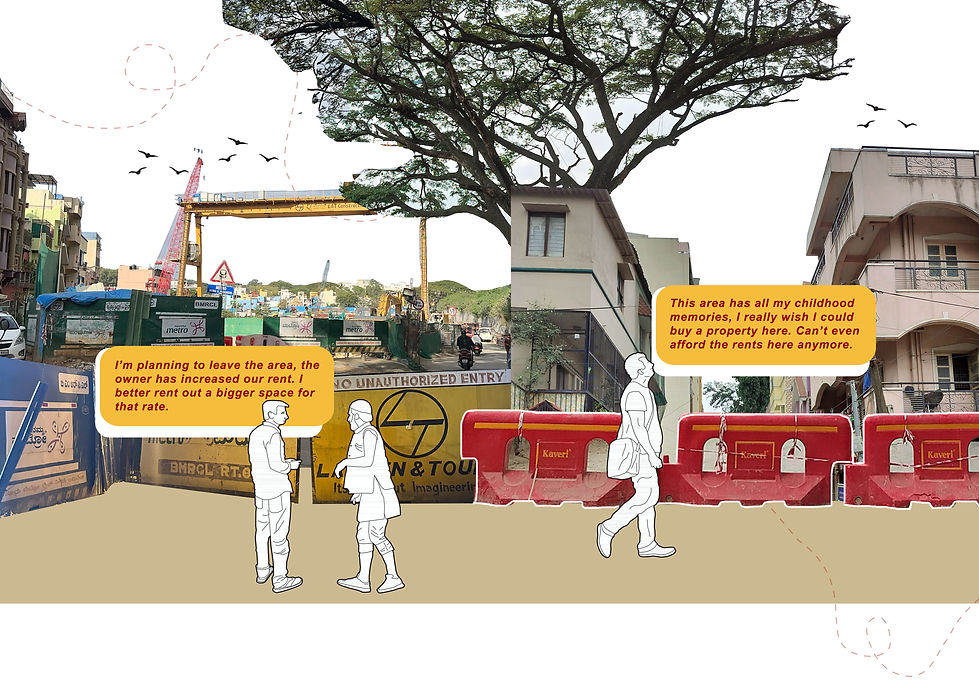
With the ongoing metro construction, the responses centred around narratives about impacts on built form and daily life
Impact on Built Form
During the initial construction phase, there were also impacts on housing structures, basic amenities (water, sump tank/bore well) and instances of accidents. They expressed concerns about structural weakness of their homes due to vibrations caused by blasting and other construction processes.
" Dukan ka bahar ka darwaja metro ke vibration se tuta, itne salo se hai kabhi aisa hua nahi, complaint kiya to kuch response nahi, maine hi apne kharche se banvaya."
(Ram Lal, 58, Pawn Broker)

Cracks developed on sump tanks leading to water leakage and resulted in higher water bills. The authorities helped to clean but there were repeated instances of the same and they had to put money from their pockets to rectify it. There were issues with water in houses to the proximity of the construction site as well and a few commented on the water situation that happened during the Kaveri water crisis and bore wells being helpful. But officials made a few to shut down their bore wells and gave a one time compensation of 2 lakhs.
"Here are cracks, [I: Any compensation?] Till now, we've not gone to a discussion or talk where they..where they seem like they're going to compensate you for any of those things"
(Saleem, 38, Resident)
The cracks developed on their homes, some of them newly modified and a few of them being really old structures raised concerns within the residents. There were a few instances of cracks that developed on tanks due to heavy machinery work on the ground and people shifted to overhead tanks. It was told that the metro officials did rectify the issues on time but isn’t sure that’s the case in every house.
"June 2019 they came and that year end... November or December they started the work on this site. In this span of one or two months, they wanted to dig out a drainage kind of, so these barricades were moved further, and that took 4-5 months. So all those things are happening, you know the barricades keep on coming...shifting and all. That is happening for a long time."
(Saleem, 38, Resident)

The occurrences of accidents during the construction phase also led to a feeling of threat amongst the residents. There were narratives that came about sunshades cracking and falling and drilling pillars possibly having created an accident due to negligence.
Impact on Daily Life
There were a few instances of severe noise that led to residents shifting their homes, having to leave ageing parents behind. The daily interactions within the homes were also affected, like difficulty watching TV, talking loud on phones and lack of sleep after a long day.
"Even though the metro is underground, the work was happening at the ground floor only. Here when they were doing the work the sound used to just be like banging in my head all the time. When I was sleeping also I used to hear that noise. Much terrible it was"
(Mani, 45, School Teacher)

The health concerns were dominant in the neighbourhood as it affected every age group.The noise resulted in hearing problems and the members of family frequently falling sick. The older generation had it difficult due to the noise and few of them shifted their ageing parents to other locations.
"Noise ke wajah se ham jaise buddho ko taqlif hota hai."
"Noise bohot zyaada hai to buddhe logo ko saans ka aur sound ka taqlif hota hai. Yahaan meri maa rehti hain, usko shuru mai taqlif hui thi."
(Raju, 72, Resident)
(Zara, 32, Resident)

Mostly, everyone had to wear masks or consult doctors due to the adverse effects of dust and allergies. The parents were also concerned about their children's health due to the absence of grounds/parks nearby leading to reduced physical activity.
There was also money loss that happened to residents in terms of having to hire domestic help to clean houses daily and paying rent to park their cars due to the barricades and other machinery on site. Damages were caused to a newly bought car, leading to them selling it. [Junaid quote] People working from home were impacted as they had to travel and find an alternative to get work done.
"Of course, we had a car over here, but we couldn't park the car anywhere. Then later on, instead of parking on the road, all rats and all those things, someone broke the windshield also after parking it outside. So it has affected us in all the ways."
(Saleem, 38, Resident)